
I have more than just books for you. Here, you will find all the activities related to the Taira book.
I am planning a two weeks trip in March/April 2027:
“Through Japan with Taira”
Send me a message, if you want to come with us, till May 31. 2026!
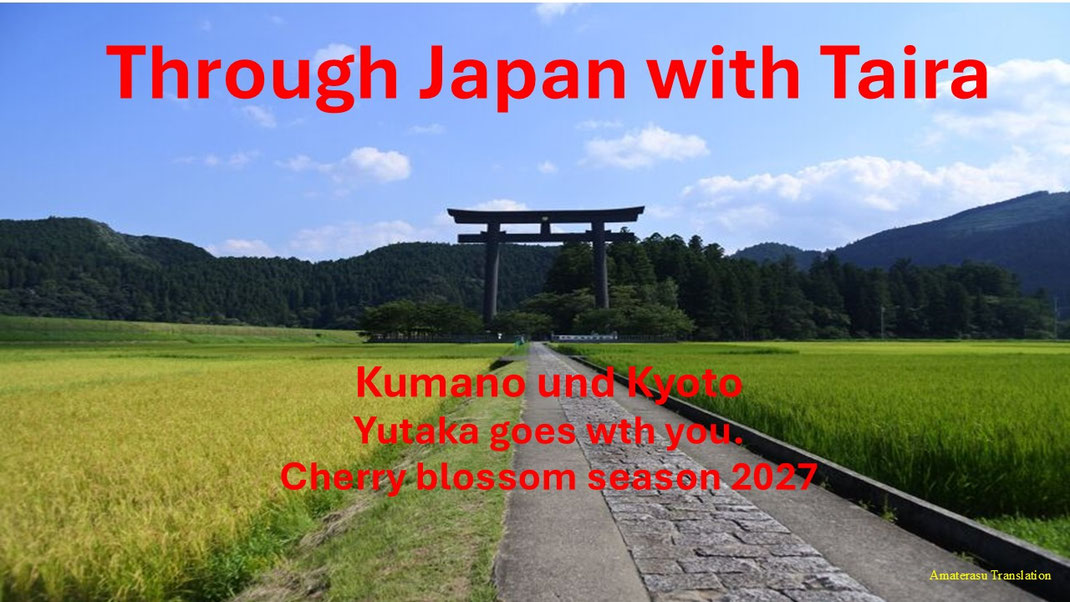
Yoshikawa’s “Taira” chronicles Japan’s ancient and medieval history. Emperors, nobles, and samurai all revered Japan’s gods and the Kannon Bodhisattva. This religious world is unique and remains the backbone of Japanese society to this day. We will hike through the two most important sites of the Shinto religion and Buddhism, Kumano and Kyoto, and immerse ourselves in their spiritual energy. I have designed this trip and will accompany the group as a guide. I will show the travel route in a transparent and cost-conscious manner so that you can plan the trip yourself if you want to undertake the travel later. I am confident that participants will gain an understanding of Japan’s historical past.
Kumano Kodo (Nakahechi, Kogumotori-goe, and Ogumotori-goe Routes)
The Kumano Kodo Nakahechi Route has been designated a UNESCO World Heritage Site and is the pilgrimage path that Japan’s emperors walked during the Taira period, as shown on the map. That is the route we will hike. I expect a path lined with cypress trees, almost deserted. We will spend the nights in a few villages. Otherwise, there are no food or lodging options along the route. It was here that Kiyomori Taira accompanied the majestic pilgrimages. Yoshitsune Minamoto stayed in Nachi by the great Nachi waterfall during his youth. Benkei hails from this area. Our starting point, Tanabe, also plays a major role in the novel. The three Kumano Taisha shrines venerate gods from Japan’s founding mythology. Our pilgrimage route:
Takijiri – Chikatsuyu – Kumano Hongu Taisha – Koguchi – Kumano Nachi Taisha – Kumano Hayatama Taisha
A 70-km pilgrimage through the Kumano Mountains.
8 nights in guesthouses along the way including one night in one of the oldest hot spring Ryokan in Japan near Kumano Hongu.

Taira’s Kyoto
The novel begins in the old imperial capital. We want to explore the heart of Taira: the former Rokuhara, Kiyomizu Temple, and the Gion district. The tragedies involving the defeated generals unfold along their escape route to the east. They fled over Mount Higashiyama toward Lake Biwa. The Kyoto Trail North follows the ancient path between Mount Hiei and Kuramadera Temple. The young Yoshitsune Minamoto, whose childhood name was Ushiwaka, grew up in this temple. To the north of Kyoto lie Arashiyama, Sagano, and Takao. Here are several historical sites from the novel and beautiful landscapes. To the south is Fushimi Shrine, and we plan to climb the staircase lined with thousands of red torii gates. Uji Byodoin Temple is also in the south. Last but not least, we don’t want to miss the Imperial Palace and the Golden Pavilion (pictured here). We will spend 7 days in Kyoto and stay in a simple guesthouse before heading from Kansai Airport toward Düsseldorf. The travel shall be undertaken just at the wonderful cherry blossom time in Kyoto.
The pilgrimage will last a total of 15 days, and I estimate the cost to be 3.200 USD for flights, train travel, accommodation, and meals at today's rate.
Airfares are currently rising rapidly due to the war in Iran. We need to monitor oil price trends and airfares and may need to adjust our travel plans. 4322 USD
based on 25. April 2026. 4696 USD on 04. May 2026 flight data.
It's so sorry to say. I have to postpone the trip to Japan.
Reading of Shin Heike Monogatari in Hamburg
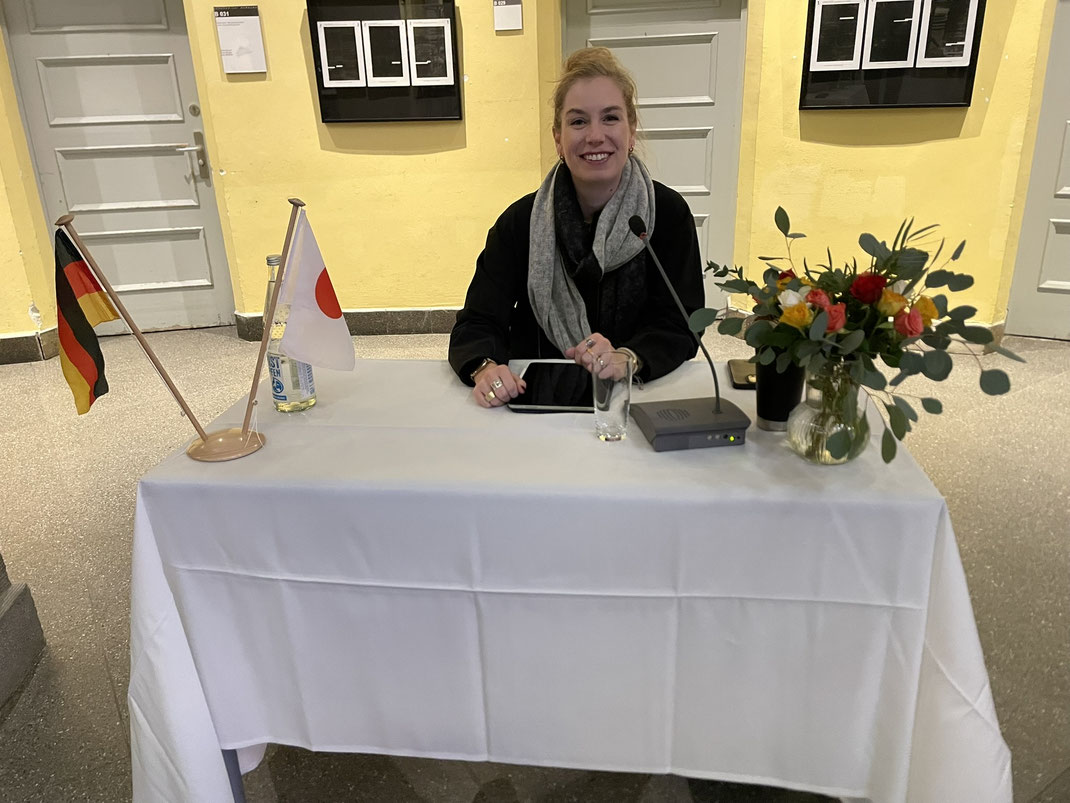
Christine Pepersack read.
The German version was read in Hamburg.
Yutaka Hayauchi, translator, spoke, and Christine Pepersack, editor, read.
Organizer: German-Japanese Society of Hamburg e.V.
Location: In the Land Registry Hall of the Civil Justice Building, Sievekingplatz 1, 20355 Hamburg
Date and Time: November 25, 2025, 6:30 p.m. to 8:00 p.m.
Dr. Hewicker of Kultur und Justiz e.V. and Ms. Eiko Hashimaru-Shigemitsu of the German Japanese Society of Hamburg e.V. welcomed Christine Pepersack and me. Christine read six passages out of the whole volume. Between the readings, I provided background and commentary on the passages.
We had the impression that the story very much interested the audience. There are only a few novels about the aristocratic society and the Middle Ages of Japan in the German language. Nobody in Germany can really imagine how the samurai lived eight hundred years ago. The audience learned that Shin Heike Monogatari has not been published in German or English before. So, they enjoyed the privilege to hear about the famous samurai story in German language. At the end of the reading, the participants asked the translator questions about details, copyright, and the long translation time of over 33 years.
If you like, although in German, you can look at short youTube sequences of the individual presentations.
Part 1: https://youtu.be/d0McSCoj7qY
Part 2: https://youtu.be/sPJr_fzRrQ4
Part 3: https://youtu.be/O3JdXUgAFps
Part 4: https://youtu.be/H_j3QtiF5g4
Part 5: https://youtu.be/Dg26BYlY7xo
Part 6: https://youtu.be/QcyG9oExhY0
Enjoy!
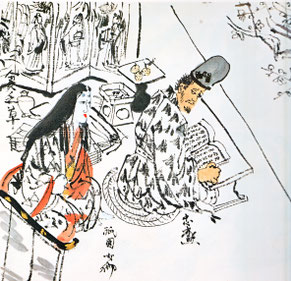
On August 22, 2024
The New Tale of Taira began with this cover image. Thanks to the kind support of the Kenkichi Sugimoto Museum, I have several of Sugimoto's works to choose from. Kenkichi Sugimoto and Eiji Yoshikawa were close friends through the novel. After the two died long times ago, one still feels Sugimoto's outstanding commitment to Eiji Yoshikawa. I take this painting for the first English translation book that is now starting. The Lady Gion symbolizes Yoshikawa's intention so clearly. You can tell from her gesture and facial expression that Kiyomori's mother, the wife of Tadamori, who looks back at her grimly, is not interested in the venerable religion of Buddhism. She is firmly convinced that she belongs to the nobles, not samurais. Sie can live the life of an aristocratic lady with her beauty.
Reading of Shin Heike Monogatari in Düsseldorf
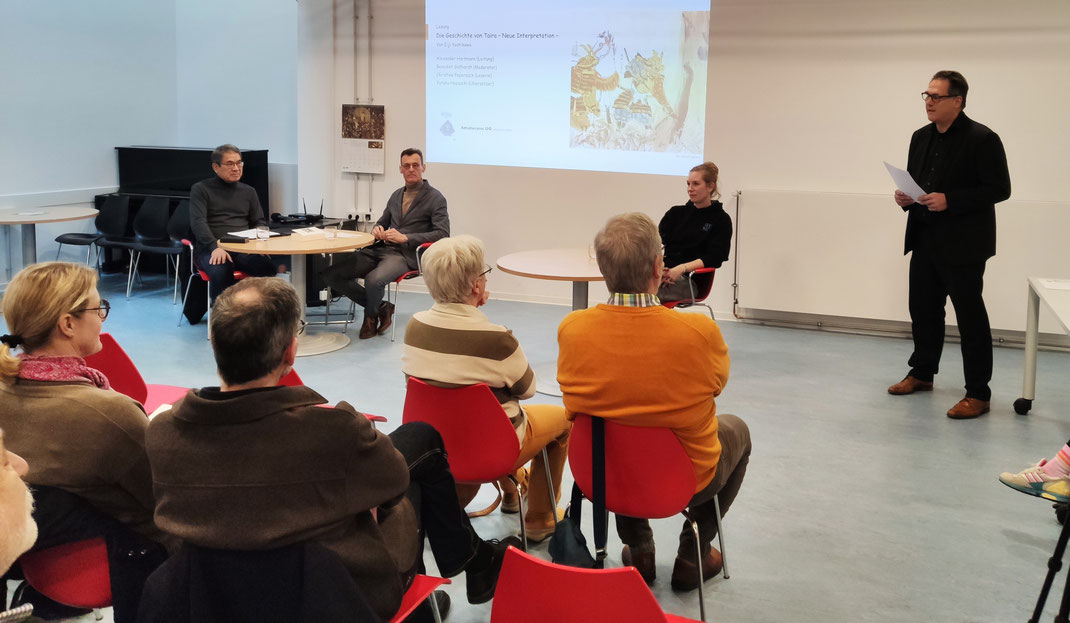
From the right to the left, you see Alexander Hartmann as organizer, Christine Pepersack as reader, Benedikt Gollhardt as moderator, and myself as translator.
The German version, Die Geschichte von Taira - Neue Interpretation - was read in Düsseldorf.
Date and Time: February 24, 2024, from 1:30 PM to 3:00 PM
Organizer: Amaterasu Translation
Attendees: 20 people
The reading was led by Mr. Alexander Hartmann (attorney). Mr. Benedikt Gollhardt (screenwriter and author) moderated the reading. Selected passages were read by the novel’s editor, Christine Pepersack. I explained the content and background. The participants applauded enthusiastically and asked Christine and me many questions. The participants got refreshments at the bar. Many attendees took the opportunity to speak with Yutaka Hayauchi.
Talk show in Masuda, Japan

Talk show on November 11, 2023 in Masuda. I was invited to speak to the people in my hometown. I lived there and went to school until I was 18. The mayor of Masuda gave me a warm welcome and thanked me for donating all my translations to the library of the city. In turn, I was able to thank my schoolteacher and painter, Ken Tanaka, who provided his woodblock prints for the cover art of all the volumes. Ms. Sachie Yamada from NPO Masuda organized the talk show. My friend Shuji Mukunoki moderated the speech. Interested residents, my friends and acquaintances, my family, and students—over two hundred people in total—attended. I told them about my life in Germany and my translation of Shin Heike Monogatari. Many were very pleased with my presentation. It was a great honor for me to be able to speak to them.